
“We don’t see things as they are, we see them as we are.” - Anaïs Nin
Imagine two people fighting.
A wants to go to a movie.
B wants to go out to dinner.
Each is unwilling to give in.
Now, let’s say, you step in and try to resolve this.
You ask what they each want.
A wants to have a good time.
B wants the same thing too.
But their idea of what a good time is is different.
So you try again.
You suggest they do separate activities, each having a good time in their own way.
A doesn’t want to do that, she prefers to do something with B.
B agrees, he would rather spend his time with A too.
We have found a common ground. Both A and B would like to spend time with each other.
This kind of conflict resolution is so common and trivial in our daily conversations that we don’t pay much attention to the mechanics of it. Which is fine for most mundane matters, however, when the conflicts run deep, and the issues get more complex, it is useful to have a tool that can help us. And the good news is that it is a technique that most of us already use, but now we will formalize it into a framework that, if you remember at the right time, you can use it to resolve diverging views or wants in many more instances.
The Ladder Of Convergence
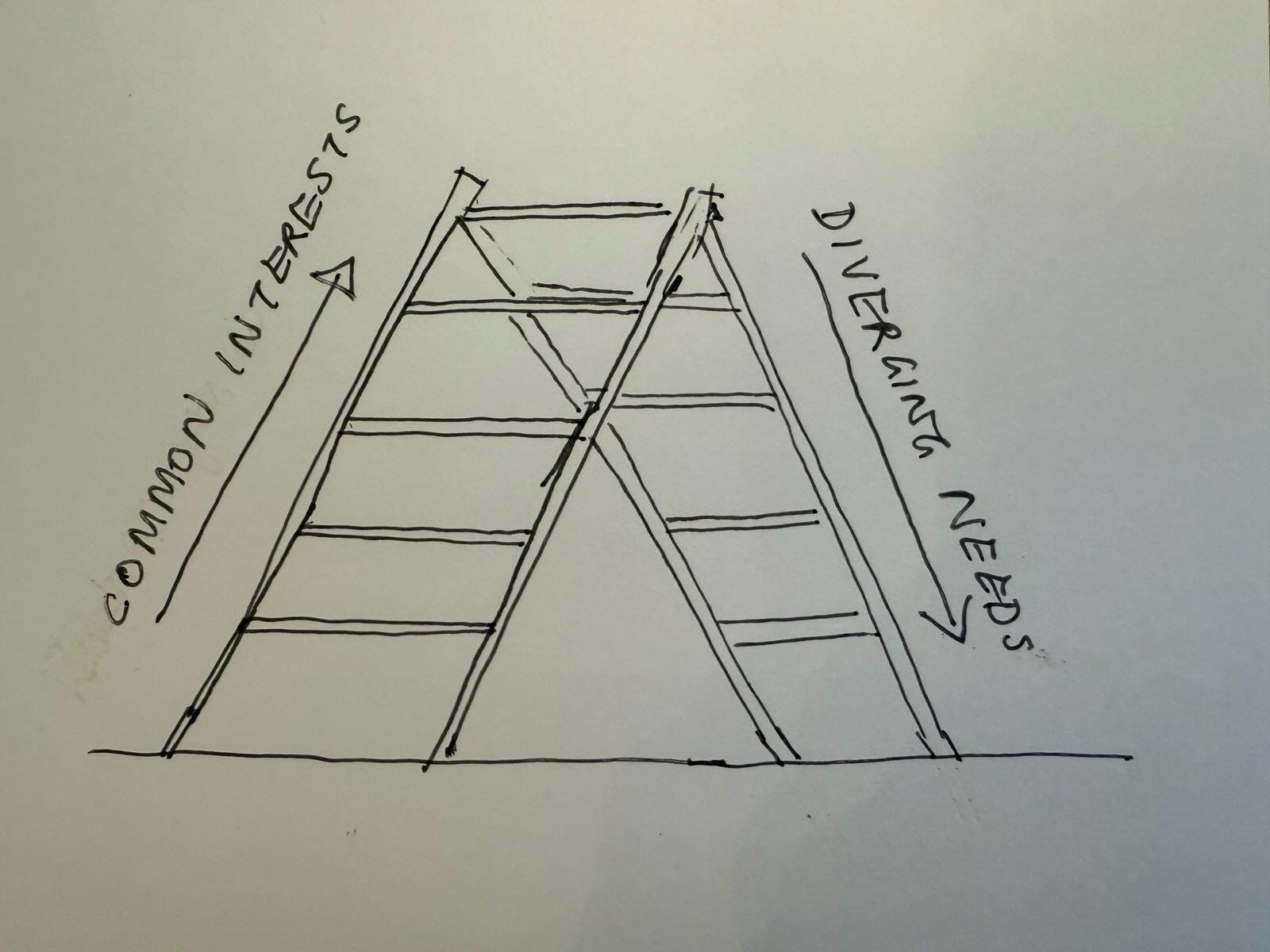
The Ladder of Convergence has two sides, picture each side with horizontal rungs, each representing a specific level of interests and needs.
On the left side, climbing up reveals our common interests - what we both care about beyond our initial positions. The higher we go, the more fundamental shared values we discover. This might be a common goal we have agreed upon (say start-up founders who can’t agree on a specific strategic direction but who both agree on the core mission), or it might be a common regard for connection or love (as often with friends or family).
On the right side, moving down acknowledges our divergent needs - the specific ways we each prefer to meet those shared interests. These differences aren’t problems but natural expressions of our individuality that would benefit from mutual respect and accommodation.
The power of this approach is that it works in both directions. When stuck, we can climb up to find common ground, then come back down with solutions that honor both our shared purpose and our unique preferences.
Most conflicts aren’t about fundamentally opposed values but about different ways to achieve what we both want.
The ladder reminds us that below every seemingly irreconcilable conflict lies a foundation of shared humanity; we simply need the patience to climb high enough to find it. The ladder helps us find that sweet spot where we can respect both what connects us and what makes us distinct.
Applying the Framework
Here’s how to use the ladder of convergence in real life:
Notice the Surface Argument - What does each person say they want? (Movie vs. dinner)
Climb Up - Ask “Why is that important to you?” Keep asking until you find what you both care about. This might be quality time, feeling respected, or achieving a shared goal. As a rule of thumb, it often takes 3-5 iterations to get to a shared rung.
Name the Common Ground - Say it out loud: “We both want to spend time together” or “We both want this project to succeed.”
Come Back Down with Respect - With shared interests clear, address each person’s specific needs: “How can we spend time together in a way that works for both of us?”
Find Creative Solutions - Look for options that satisfy both the shared goal and individual preferences - maybe dinner at a place with entertainment, or a different activity altogether that you both enjoy.
Try it out next time you have a disagreement, whether it is family discussions about holiday plans, work disagreements on how to tackle a project or roommate conflicts about house rules. Practise it often, and soon you’ll find yourself naturally asking: “Where on the ladder are we stuck, and which way do we need to move now?”