
“The same stream of life that runs through my veins night and day runs through the world and dances in rhythmic measures.” — Rabindranath Tagore
1976. Los Angeles.
David Bowie was at the height of his fame. In interviews, though, he called it “the darkest days of my life.” Addicted and paranoid, he felt creatively drained. Riddled with self-doubt, he felt, as he told Rolling Stone, that he, “needed to go somewhere where I could think and breathe.” He fled to Berlin, a city where he felt that nobody cared who you were, and a place where he could lose himself and thus find himself again.
In Berlin, Bowie painted, cycled anonymously through Schöneberg, and began rebuilding himself from silence. It was a period of shedding, a return to stillness and uncertainty that eventually opened the way for reinvention. Through long nights in the studio with Brian Eno and Tony Visconti, the fragments began to cohere. Out of experimentation came the Berlin Trilogy (Low, Heroes, Lodger), music that sounded like nothing else of its time.
As Bowie started feeling comfortable in the new skin, a period of stability, control and clarity ensued, the phase of the late-mid 1980s with music such as “Let’s Dance.” It was a calculated move to reach a wider audience.
Eventually, this success would cast a shadow, and he would find himself stuck again. But he would go on to disintegrate and reinvent multiple times, performing with the band Tin Machine in the 1990s and then, giving us later hits like Outside, Heathen, and Blackstar in his late 1990s-2010s resurgence.
David Bowie was a legend. His creative arcs, on closer inspection, gives us a very useful framework to think about the nature of time that we find ourselves in, in any period in our lives.
Strip away the stage lights and the rockstar halo, and we can see that the rhythms of time are just as applicable for any of us.
The States of Time
Like matter, time has states too. Existing within time, we rarely see them as clearly as we do the states of matter. Sometimes it is solid, when life feels grounded and predictable. Sometimes it is fluid, as we move between solid states. Sometimes it expands like gas, distracted and unconstrained. And sometimes it burns like plasma, charged with energy, breaking down old forms so something new can emerge.
Often, we move through these states without noticing. Recognizing which one we’re in is the beginning of working with time, not against it.
Here is a short frame that helps to identify what state you are in:
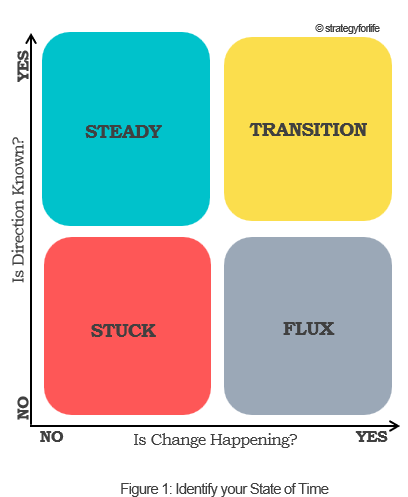
The framework illustrated captures four fundamental states we all cycle through in our creative and personal journeys, based on two key dimensions: whether we know our direction and whether change is happening.
STEADY: When direction is known and change is not happening. This represents periods of stability, productivity, and mastery—times when we’re confidently executing a vision with clarity and purpose.
While Steady sounds great, in the real world, it rarely lasts long. More often than not, even when we think we are in a steady state, we’re actually...
STUCK: When direction is not known and change is not happening. This is the place of frustration and stagnation. We feel immobilized and unclear about where to go next. It’s comfortable enough that we don’t make changes, yet uncomfortable enough that we feel discontent.
Often to get out of stuck, you need to be willing to put yourself in a phase of...
FLUX: When direction is not known and change is happening. This is a period of experimentation, openness, and uncertainty—embracing the unknown and trying new approaches without knowing exactly where they will lead. It feels chaotic but is ultimately generative.
Eventually, Flux gives way to...
TRANSITION: When direction is known and change is happening. This is the bridge between vision and reality, where transformation occurs deliberately as we move toward a clear destination. The path becomes visible, and implementation takes center stage.
Applying the Framework
Each quadrant calls for an appropriate and specific approach:
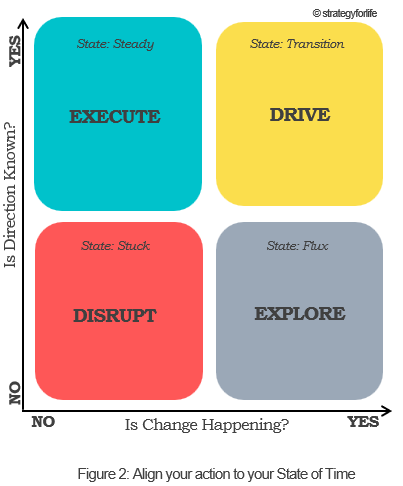
Steady rewards Execution. Use stability to refine, master, consolidate and build depth.
Stuck requires Disruption. Break the pattern, question your defaults, and step away from familiar ground.
Flux invites us to Explore. Release control, stay open, and let new patterns surface through uncertainty.
Transition demands Drive. Move with intent, think with clarity and move forward with energy, push purpose into form.
Each state has its place (and time); the wisdom lies in knowing which one you’re in and responding appropriately. Ask yourself three questions:
Are you aware of which phase you’re in?
Do you accept it, instead of resisting it?
Are your actions aligned with what that state demands?
The framework starts with identifying where you are, and then embracing the natural cycle. When stuck, seek disruption deliberately like Bowie’s move to Berlin. When in flux, resist the temptation to prematurely define your path. Cycle aimlessly through the streets of Berlin, if that suits you too. When in transition, maintain momentum through disciplined action. Define your vision, find your crew, get started. And when you reach steady, use that stability to deepen your mastery rather than becoming complacent, until eventually the Stuck state sets in again.
Like Bowie, we can learn to navigate these rhythms of time with intention, allowing each phase to serve its purpose in our larger creative and personal evolution.